What about the possibility that a brand, like an artist or a person, can become more itself by ceasing to resemble what it used to be?
After college, where I studied film and not design, I had a design studio with my partner, who was a trained designer. Back then I understood design only as the midwife to THE IMAGE — the one idea that made a brand unique, whole, and unforgettable, expressed visually.
My partner was a real designer. Graphics was her language, and she was exceptionally good at it. She was quite the iconoclast too. Broke all the rules, in spirit if not in practice, because she considered design rules a betrayal that took design from an art to a craft. One thing that always chafed her was why logos must always be the same, static, changeless until rebrands, which usually happen many years apart, if at all.
As someone coming from film, I had to agree. Film directors have themes they explore and stories they tell again and again, but their films don’t look the same. They respond to culture and technology and talent, but deliver a vision that cannot be anyone else’s.
So why should a brand be beholden to the same look in a culture that changes almost daily?
Later in my work as an AD and CD, I encountered her type of thinking less and less. Things were set and rigid, and change was abhorred. Then brand rules became systems and the prison walls thickened.
Design itself stopped being art at all and became rules that begat rules.
For most of (branding) history, permanence was a technological necessity. Logos and other identifying marks had to be printed, stenciled, painted, chiseled. Consistency wasn’t easy to establish and it was expensive to change.
Digital environments remove much of that constraint.
Software changes exactly the things brand guidelines protect most: color, layout, the logic of how things work. People already accept drastic change to the very elements brands treat as untouchable and recognition survives it.
A brand could generate a different expression every time you encountered it. Not randomly, but according to its own logic. Its appearance might respond to time, context, interaction, perhaps even the history of an individual user's relationship with the brand.
An identity needn't be a fixed collection of visual characteristics or a fixed philosophy. It could be a continuous creative history. It could be something that emerges through successive acts of creation. It could be that a brand discovers and continually redefines its identity through the things it makes.
A brand needn't look the same to remain itself. Fashion does it all the time. MTV did it. Film does it — one would know a David Lynch film by the choices he makes even without seeing his name in the credits.
A brand identity could live in the way the rules are being broken.
I did it a few times, when brand (and boss) allowed it. One example below, for Dassault Falcon Jet:
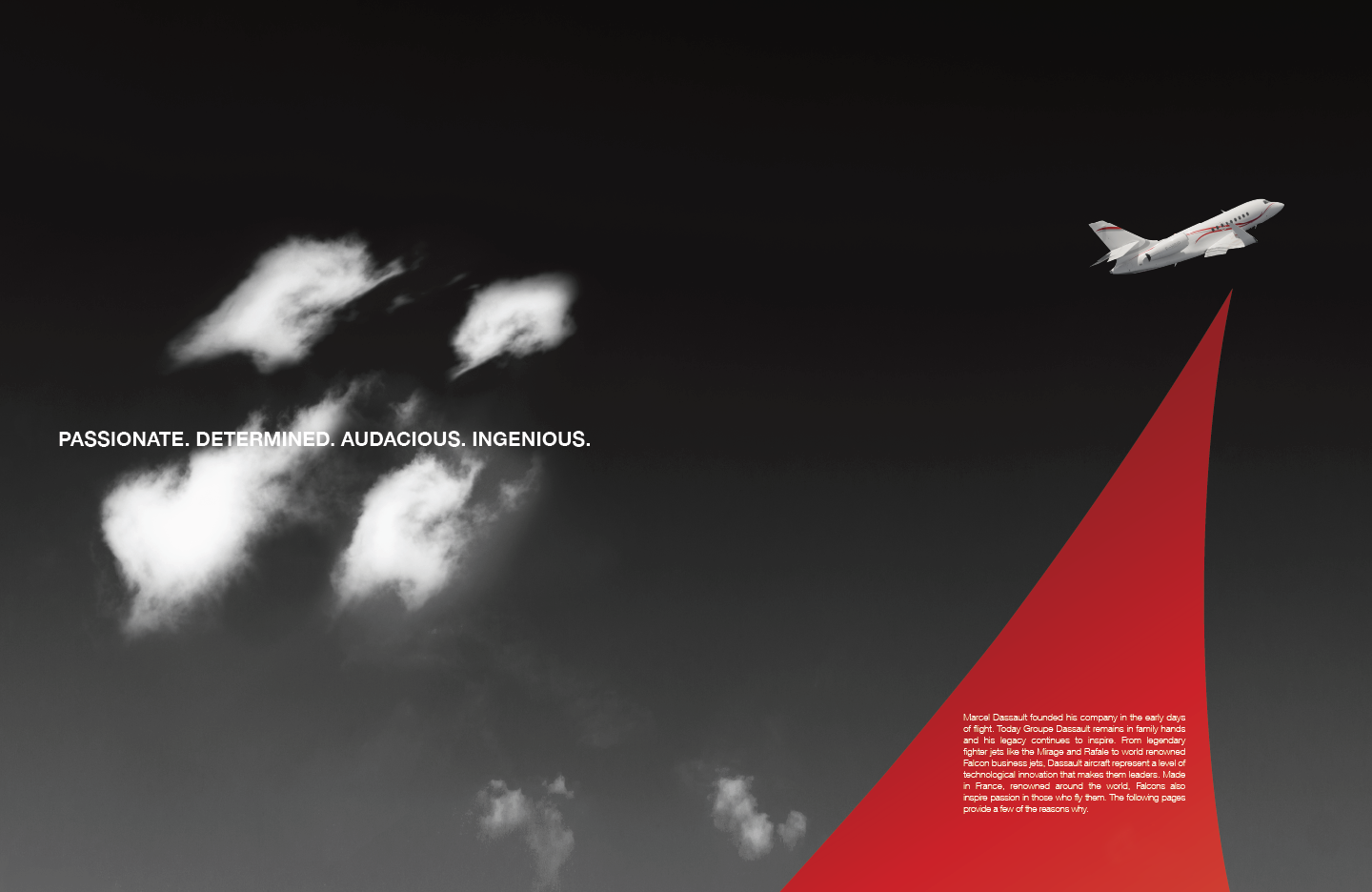
Traditional branding assumes that a brand's identity resides in the artifact: the logo, the color, the font, the system.
Change too many of those things, and the identity disappears. That’s the rule.
So — you might ask — if every visual element can change, what exactly does the audience learn to recognize?
I think recognition can be achieved through a more sophisticated engine — a consistent way of thinking that is capable of producing inconsistent expressions. As I mentioned above — fashion has learned how to accomplish exactly this.
A fashion house can employ different photographers, models, locations, stylists, and/or creative approaches. One campaign might be laconic, austere, next one — vulgar, theatrical, surreal. Still, the brand can persist. Prada looks like Prada. Versace looks like Versace. How?
Because the brand isn't simply what we see. The brand is the authorship behind what we see. The spark. The vibe. The attitude.
I am not stating that fashion houses completely abandon recognizable products, symbols, histories, and cultural associations. Their freedom isn't absolute. And it isn’t chaotic.
No. Nonetheless, they prove that identity can survive considerable visual discontinuity.
And I am not arguing infinite variations. To a designer they sound like an apple to bite into, but no.
Infinite variation can become yet another shackle. The opportunity is not the quantity of expressions — 10 000 logo changes lose the brand and lose the viewer.
I am also not arguing infinite variations within an established aesthetic. A brand would need permission to introduce the unexpected, to light another light, and to incorporate successful departures into an evolving identity. In other words, the system must be capable of breaking its own rules. A brand could be photographic today, typographic tomorrow, spatial next week, and something entirely different next year.
The question then changes from — ‘Does this fit within our identity?’ to ‘Can we absorb this idea, look and style into our identity now?’ — bringing about a fascinating rift in our current creative thinking.
And all the above brings us (well, me) to obvious conclusions —
What would you design if you knew that nothing you designed had to remain the same? Not just the logo — the entire identity.
What would a brand become if its identity were defined not by what it walls off, but by how it evolves?
I’d want to see.